
Brief Summary
This video provides a detailed overview of the scapula, also known as the shoulder blade. It covers the primary bony landmarks, including the medial and lateral borders, subscapular fossa, acromion, acromioclavicular joint, spine of the scapula, supraspinous and infraspinous fossae, glenoid cavity, supraglenoid and infraglenoid tubercles, coracoid process, and suprascapular notch. The video explains the anatomical significance of each landmark, including muscle attachments and articulations, and their relevance in understanding muscle names and shoulder movement.
- The scapula, or shoulder blade, is a flat, irregularly shaped bone with several key bony landmarks.
- Understanding these landmarks is crucial for comprehending muscle attachments, joint articulations, and overall shoulder function.
- The video uses visual aids and etymological explanations to enhance understanding and retention of the anatomical terms.
Intro to the scapula
The scapula, also known as the shoulder blade, is a flat and irregularly shaped bone. The video aims to identify the primary bony landmarks of the scapula and explain their significance.
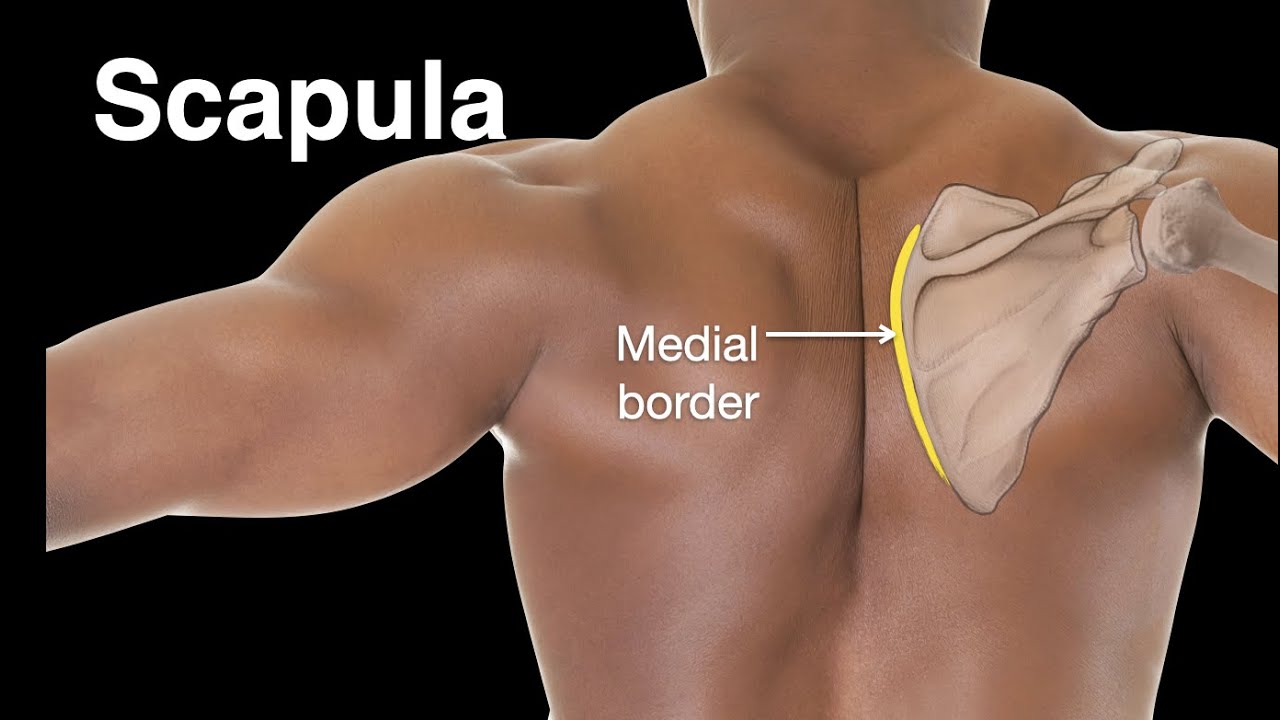
Medial (vertebral) border
The medial border of the scapula is the side closest to the vertebral column. It is also referred to as the vertebral border due to its proximity to the spine.
Lateral (axillary) border
The lateral border of the scapula is located on the side of the bone. It is also known as the axillary border because of its closeness to the armpit.
Subscapular fossa
The subscapular fossa is a shallow concave surface found on the deep, anterior surface of the scapula, lying against the ribs. The prefix "sub" means deep. It is also referred to as the costal surface. The subscapularis muscle originates from this fossa.
Acromion
The acromion is the highest point of the shoulder. The term "acron" in Greek means highest, and "omos" refers to the shoulder. It is a flat and large surface on the scapula.
Acromioclavicular (AC) joint
The acromion articulates with the clavicle, forming the acromioclavicular (AC) joint. This synovial plane joint is crucial for shoulder movement, allowing the arm to move up and down due to the coordinated movement of the clavicle and scapula.
Spine of the scapula
The spine of the scapula is a prominent ridge on the posterior side of the scapula. The trapezius muscle anchors to it, providing support and movement to the scapula, while the deltoid muscle also attaches to it, aiding in humerus movement.
Supraspinous fossa
The supraspinous fossa is a shallow concave surface located above the spine of the scapula on the posterior side. It is named for its location superior to the spine.
Infraspinous fossa
The infraspinous fossa is a shallow concave surface located below the spine of the scapula. It is named for its location inferior to the spine. The supraspinatus muscle is located in the supraspinous fossa, and the infraspinatus muscle is located in the infraspinous fossa.
Glenoid cavity (glenoid fossa)
The glenoid cavity, also known as the glenoid fossa, is a shallow socket on the lateral side of the scapula that articulates with the head of the humerus to form a ball and socket joint. The term "glenoid" means socket in Greek.
Supraglenoid tubercle
The supraglenoid tubercle is a bony prominence located above the glenoid cavity. A tubercle is a bony prominence usually for muscle or ligament attachment. The long head of the biceps brachii muscle attaches to the supraglenoid tubercle.
Infraglenoid tubercle
The infraglenoid tubercle is a bony prominence located below the glenoid cavity. The long head of the triceps brachii muscle attaches to this tubercle.
Coracoid process
The coracoid process is a bony projection that resembles a raven's or crow's beak. In Greek, "coracoid" means raven's beak. Three muscles attach to the coracoid process: the pectoralis minor, the short head of the biceps brachii, and the coracobrachialis. It can be palpated in surface anatomy just below the lateral third of the clavicle.
Suprascapular notch
The suprascapular notch is located on the superior border of the scapula. The suprascapular ligament crosses this notch, forming a foramen through which the suprascapular nerve passes, while the suprascapular artery runs above the ligament.
Practice and In-a-Nutshell
This section reviews the key bony landmarks of the scapula, including the lateral border, glenoid cavity/fossa, coracoid process, subscapular fossa, acromion, spine of the scapula, supraspinous fossa, and infraspinous fossa.

