
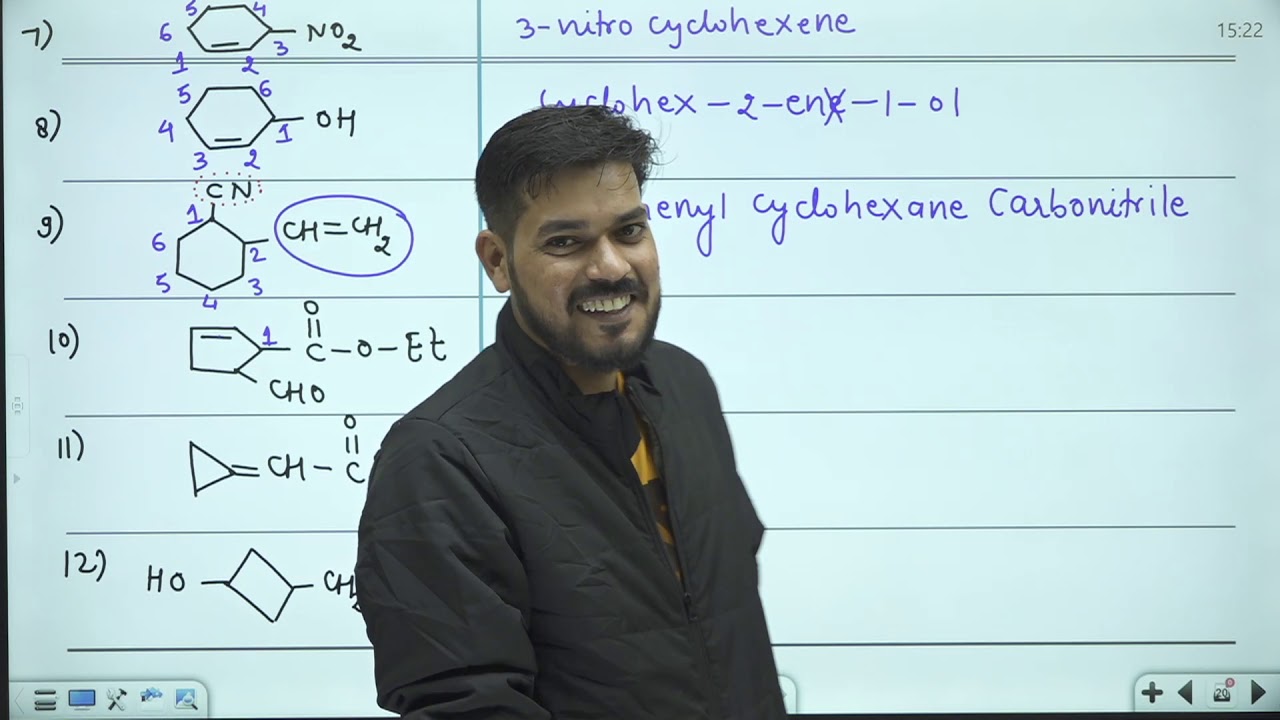
Brief Summary
This video provides a comprehensive guide to IUPAC nomenclature in organic chemistry, focusing on complex scenarios and exceptions to standard rules. It covers priority of functional groups, numbering conventions, and how to name compounds with multiple substituents, cycles, and complex side chains. The video emphasizes practical application through numerous examples, helping viewers develop a systematic approach to naming organic compounds accurately.
- Prioritization of functional groups and substituents in IUPAC nomenclature.
- Numbering conventions for complex organic molecules.
- Naming compounds with multiple cycles, side chains, and functional groups.
- Practical application through numerous examples.
Introduction
The video starts with a welcome message and quickly transitions into the core topic of IUPAC nomenclature. It sets the stage for a detailed exploration of naming conventions in organic chemistry.
Priority Rules and Functional Groups
The discussion begins with priority rules, emphasizing that in compounds with multiple functional groups, the one with the highest priority determines the suffix name. Examples include carboxylic acids, esters, and nitriles. The presenter explains how to identify and number the parent chain, ensuring the principal functional group gets the lowest possible number.
Substituents and Side Chains
The video covers how to name and number substituents or side chains attached to the parent chain. It explains the use of prefixes like methyl, ethyl, and propyl, and how to indicate their positions with numbers. Special attention is given to complex substituents, where numbering within the substituent is necessary, using terms like "1-methylpropyl."
Cyclic Compounds
Cyclic compounds are addressed, explaining how to name them using the prefix "cyclo-". If a cyclic compound is attached to an open chain with a higher number of carbon atoms, the cyclic part is treated as a substituent. The presenter also discusses spiro compounds, where two rings share one carbon atom, and how to number them.
Multiple Functional Groups and Special Cases
The video explains how to handle compounds with multiple identical functional groups, using prefixes like "di-," "tri-," and "tetra-." It also covers special cases where functional groups are directly attached to a ring, and how to use terms like "carboxylic acid" instead of "-oic acid" in such cases.
Alkenes and Alkynes
Alkenes (double bonds) and alkynes (triple bonds) are discussed, emphasizing their priority in numbering the parent chain. The lowest possible numbers are assigned to these multiple bonds. If both a double bond and a triple bond are present, the double bond gets priority in numbering.
Complex Examples and Problem Solving
Several complex examples are presented to illustrate the application of IUPAC rules. These examples involve multiple substituents, functional groups, and cyclic structures. The presenter systematically works through each example, explaining the reasoning behind each step and decision.
Bridged and Spiro Compounds
Bridged bicyclic compounds, where two carbon atoms connect two rings, are explained. The nomenclature involves counting the number of carbon atoms in each bridge and using square brackets to indicate these numbers. Spiro compounds, sharing only one carbon atom, are also revisited with detailed examples.
Priority of Substituents and Alphabetical Order
The importance of alphabetical order when naming multiple substituents is highlighted. The presenter clarifies that prefixes like "di-," "tri-," and "tetra-" are not considered when determining alphabetical order.
Common Mistakes and Exceptions
The video addresses common mistakes made in IUPAC nomenclature and exceptions to the general rules. This includes cases where common names are preferred over systematic names and situations where the standard rules may lead to ambiguous names.
Practice Questions and Review
The presenter encourages viewers to practice naming organic compounds using the rules discussed in the video. Several practice questions are presented, and the presenter works through them, reinforcing the concepts and providing additional tips.
Advanced Concepts and Functional Group Transformations
Advanced topics such as functional group transformations and reactions are briefly touched upon, showing how IUPAC nomenclature is essential for describing chemical reactions accurately.
Closing Remarks and Encouragement
The video concludes with encouragement for viewers to continue practicing and mastering IUPAC nomenclature. The presenter emphasizes the importance of a systematic approach and attention to detail for success in organic chemistry.

