
Brief Summary
This video explores the concept of great books as tools for achieving full humanity by understanding the universe and human existence. It challenges materialistic views taught in schools, asserting that humans possess both a material body and a soul connected to the divine. The lecture introduces philosophical concepts such as Kant's distinction between "noumena" (objective reality) and "phenomena" (perceived reality), and Plato's allegory of the cave, which illustrates humanity's enslavement to illusion. It also discusses methods for seeking freedom through meditation, psychedelics, self-denial, near-death experiences, and the Christian concept of Christ consciousness. The ultimate goal is to achieve immortality, reincarnation, and godhood by embracing love and imagination, and by recognizing the power of consciousness to shape reality.
- Great books reveal secrets of the universe and human existence.
- Humans have both a material body and a soul connected to the divine.
- Freedom can be achieved through meditation and other practices.
- Consciousness shapes reality, and imagination is a powerful force.
Introduction: What is a Great Book?
The lecture begins by defining a great book as something that makes you fully human by revealing the secrets of the universe and what it means to be human. It challenges the materialistic perspective often taught in schools, which suggests that reality is limited to what can be seen, observed, and measured. This perspective is described as a "great lie" because it fails to address fundamental questions about consciousness and the nature of being human. The speaker asserts that humans have both a material body and a soul, with a spiritual spark connecting them to the divine, enabling love and imagination.
The Nature of Reality and Consciousness
The lecture introduces Emanuel Kant's philosophy, which divides the world into "noumena" (objective reality) and "phenomena" (our perception of reality). Kant suggests that we translate noumena into phenomena through the filters of time and space. Julian James builds on this idea by proposing that the brain's right hemisphere connects to the noumena, while the left hemisphere translates it into phenomena. The noumena is metaphorically described as consciousness, originating from energy vibrations emanating from a source called the "monad" or God, which breathes emanation to create vibrations throughout the universe.
The Material World and Human Condition
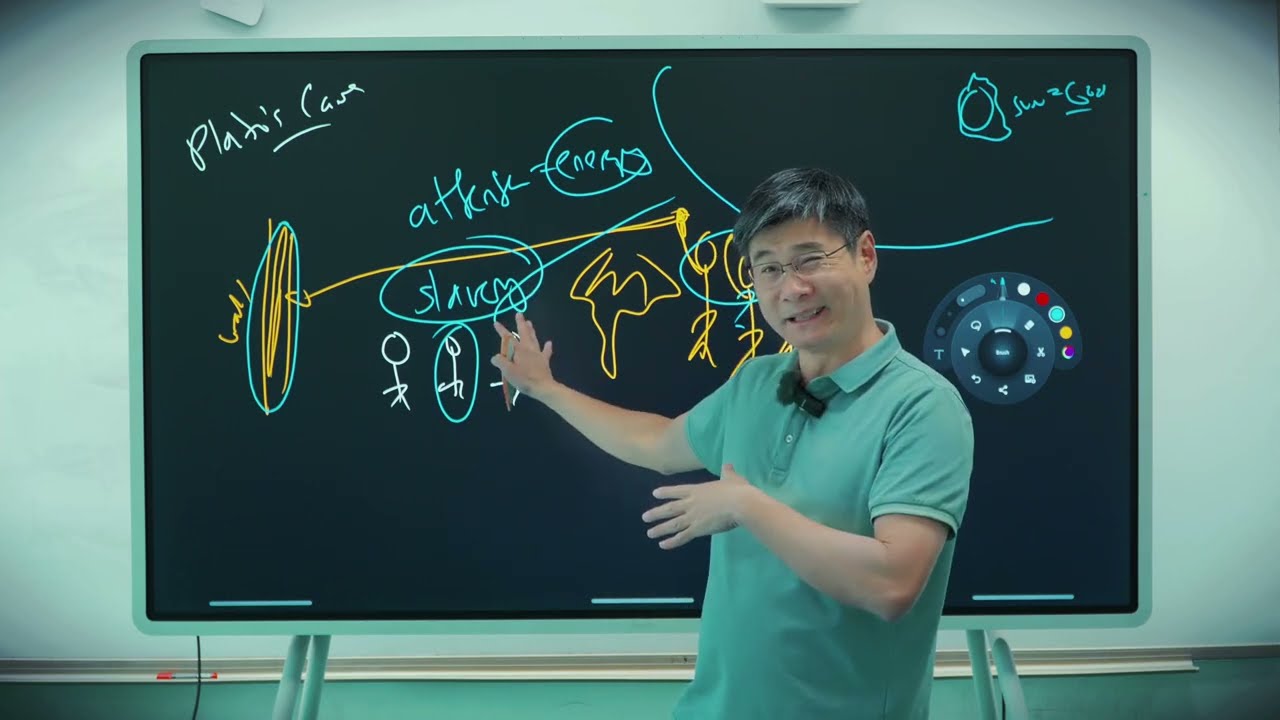
The material world is created as vibrations slow down, leading to physicality. However, the material remains connected to the spiritual. Consciousness is described as an infinite-dimensional entity, where individuals are both unique and connected to everything in the universe. To explain the human condition, the lecture uses Plato's allegory of the cave, where prisoners mistake shadows for reality, manipulated by others seeking to enslave them by capturing their attention and energy.
Freedom and the Path to Enlightenment
Freedom is defined as escaping the system of illusion and thinking for oneself. In Plato's allegory, this involves breaking free from the cave and seeing the real world, initially being blinded by the light but eventually recognizing its beauty and infinity. The lecture suggests that every religious tradition proposes meditation as a solution to seek freedom. Meditation involves understanding sacred geometry, which governs the flow of vibrational energy, and harmonizing one's consciousness with the universe through breathwork.
Hacks to Accessing True Consciousness
The lecture discusses alternative methods to access true consciousness, including psychedelics, which disrupt the left hemisphere and allow focus on the right hemisphere to see the noumena. Self-denial through fasting or exposure to extreme conditions can also shift consciousness to the spiritual as the body approaches death. Near-death experiences (NDEs) provide a glimpse into the spiritual realm, characterized by compassion, love, and connection with the divine.
Christ Consciousness and Resurrection
The lecture explores the Christian concept of Christ consciousness, suggesting that humans are active participants in reality, implanting memories into the universe through their imagination. By collectively imagining something to be true, it becomes true, as exemplified by Jesus' immortality due to the love and belief of billions. The lecture proposes that one can resurrect Jesus by making their body a vessel for him through spiritual practices like love, generosity, and forgiveness, opening oneself to divinity and the second coming of Jesus.
The Great Secret and the Role of Great Books
The universe exists in our consciousness, and by imagining, we participate in and change the universe. Focusing on a certain reality makes it manifest. By living in the memories of others, we become immortal, and by constructing our lives to allow for Jesus' return, we can resurrect him within ourselves. The lecture concludes by stating that the secrets to immortality, reincarnation, and godhood lie in love and imagination. The great books capture the universe and provide access to its secrets, offering a path to becoming fully human.
The Path to Enlightenment Through Great Books
The lecture emphasizes that achieving immortality and godhood through great books is a lifelong journey requiring sacrifice and dedication. It is not a quick fix but a path that demands abandoning materialistic pursuits and embracing the wisdom of the great books. Just as Christians seek to be possessed by Jesus, the goal is to welcome the greatest minds of human civilization, such as Homer, Plato, and Dante, into our consciousness. The lecture concludes by stating that this class is a sample, and it is up to the individual to dedicate their life to this pursuit.
Discussion: Slavery, Freedom, and Reality
The discussion addresses the nature of slavery and freedom, emphasizing that individuals have the power to create reality but are often tricked into creating a reality desired by those in power. The lecture asserts that true freedom comes from refusing to be a slave, rejecting societal norms, and recognizing that happiness does not depend on money or external validation. It acknowledges the difficulty of this path due to the fear of social isolation and condemnation but emphasizes that death is not the worst thing; slavery is.
Pain, Suffering, and the Purpose of Existence
The lecture addresses the question of why we feel pain and have bodies, stating that the universe constructs these experiences to promote imagination. Pain and suffering are necessary for meaning and achieving one's full potential. Without evil, there can be no good, and it is through choosing good in the face of evil that life gains meaning. The lecture concludes by encouraging the audience to read the great books, which will provide the energy and strength to liberate themselves. The semester's reading list includes the Iliad, the Odyssey, the Republic, the Aeneid, and the Divine Comedy.

