
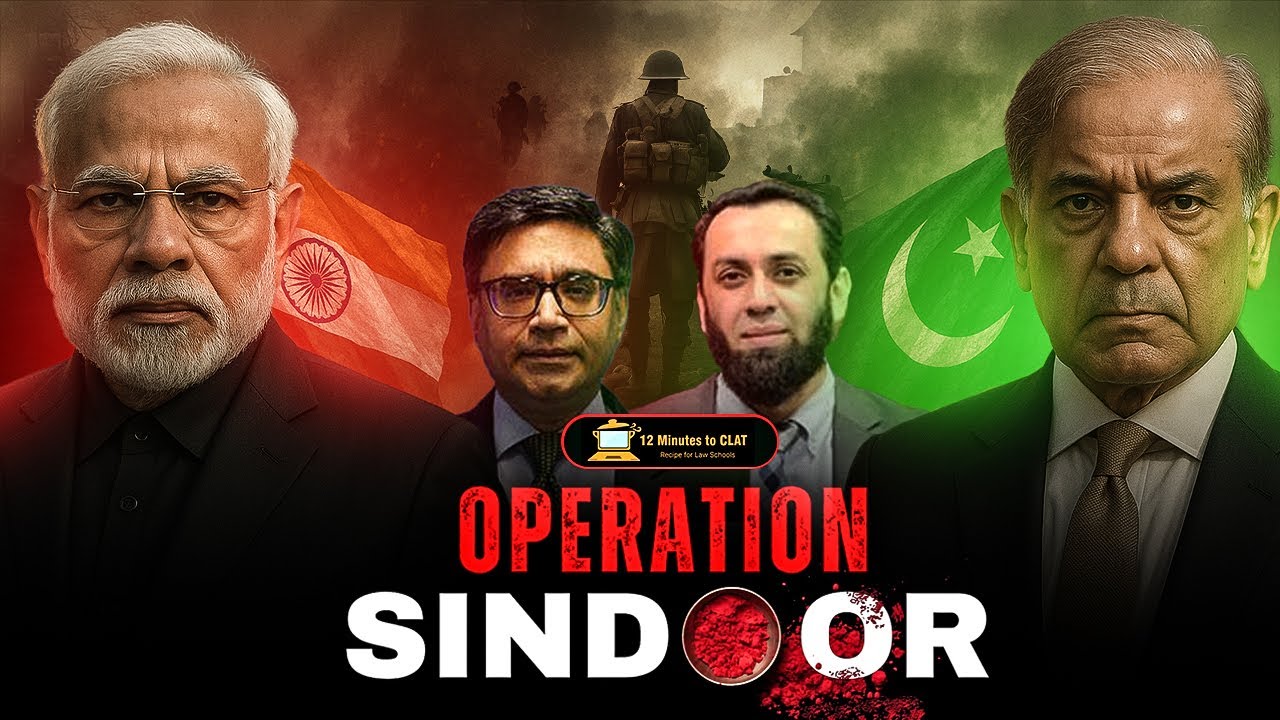
Alright, here's a summary of the YouTube video on Operation Sindoor and related India-Pakistan history, presented in an Indian English style:
Brief Summary
This video by 12 Minutes to CLAT discusses Operation Sindoor, India's response to Pakistani terrorism, and the broader history of conflict between India and Pakistan. It covers key events, diplomatic actions, and military operations, providing context for understanding the ongoing tensions.
- Operation Sindoor was a counter-terrorism attack by India in response to the killing of 26 people in Pahalgam.
- India downgraded diplomatic relations, expelled Pakistani military advisors, and suspended the Indus Water Treaty.
- Pakistan retaliated by suspending the Shimla Agreement and closing the Wagah border.
- The video also gives a brief history of the Kashmir conflict, including the role of Maharaja Hari Singh and Article 370.
Introduction to Operation Sindoor
The video starts with a welcome note and an introduction to the topic of discussion: Operation Sindoor. It's mentioned that the topic has multiple aspects, including the Indus Water Treaty suspension and Pakistan's retaliation with the Shimla Agreement. The speaker clarifies that the session will focus on the initial strikes on terrorist camps in Pakistan and a general overview of India-Pakistan operations.
New Batches Announcement
Before diving into the main topic, the speaker introduces new batches for CLAT and AILET 2026 (Anirudh and Anirudh Plus) and 2027 (Shikhar). Anirudh Plus includes offline mock tests and books. A discount code "Malpani" is provided for these batches. Contact numbers and the website (12minutestoclat.com) are shared for more information and demo classes.
Operation Sindoor: The Retaliation
Operation Sindoor was a counter-terror attack on May 7th, where India conducted precision ground strikes on nine key terrorist infrastructure sites. This was in response to the killing of 26 people in Pahalgam by Pakistani terrorists. The operation was named "Sindoor" after a viral photo of a newly-wed woman mourning her husband killed in a terror attack. Pahalgam, also known as the Valley of Shepherds, is located in the Anantnag district of Jammu and Kashmir. The terror attack occurred on April 2nd, leading to pressure on the Indian government to retaliate.
India's Diplomatic and Economic Retaliation
Following the Pahalgam attack, India took several steps, including downgrading diplomatic relations and giving Pakistani diplomats a deadline to leave India. All Pakistani military advisors in India were expelled, and the Attari-Wagah border gates were closed. India also suspended the Indus Water Treaty, putting India in a strategic position as the rivers originate there. Pakistan's defense, navy, and air force advisors were designated as persona non grata, barring them from entering India. Indian military advisors in Islamabad were also recalled.
Pakistan's Retaliatory Measures
Pakistan retaliated by suspending the Shimla Agreement and closing the Wagah border. They also reduced the strength of Indian diplomats and staff members in Pakistan by half, mirroring India's actions.
Details of the Strikes
Operation Sindoor primarily targeted six cities in Pakistan's Punjab province. The largest attack was in Ahmedpur Sharkia, near Bahawalpur, believed to be the residence of Jaish-e-Mohammad's main terrorists. It's believed that 10 family members of the Jaish-e-Mohammad leader were killed in this offensive. The targeted locations included Muzaffarabad, Kotli, Sialkot, Shakargarh, Muridke, and Bahawalpur.
Targeted Terrorist Organizations
The operation targeted camps belonging to Lashkar-e-Taiba (LeT) and Jaish-e-Mohammad (JeM). India aimed to avoid civilian casualties, focusing solely on terrorist infrastructure. Four LeT locations were targeted: two in Muzaffarabad, one in Sialkot, and one in Muridke, Punjab. These included Markaz Taiba Sialkot facility and Muzaffarabad camp Bilal Mosque complex. Four JeM sites were also hit, primarily in Bahawalpur, including a safe house, Kotli camp, Tera Kallan camp, and Markaz Subhan Allah. Additionally, a Hizbul Mujahideen site, the Bhimber camp, was targeted.
Lashkar-e-Taiba (LeT) Details
Lashkar-e-Taiba is an Islamist militant group from Pakistan and the militant wing of Markaz-ud-Dawa-wal-Irshad. Founded in the 1980s, it initially targeted Sikh and Hindu populations in the Jammu region. Hafiz Saeed, the founder of LeT, was one of the masterminds of the 26/11 Mumbai attacks.
Jaish-e-Mohammad (JeM) Details
Jaish-e-Mohammad was founded by Masood Azhar, whose family members were reportedly killed in the recent strikes. The name translates to "Army of Muhammad." Masood Azhar was arrested in 1994 but released in 1999 after an Indian plane was hijacked. He is considered a global terrorist by the United Nations since 2019. Pakistan is accused of funding terrorism, with the army holding significant power. The speaker mentions that Western countries also have a role in continuing conflicts because they produce arms and ammunition. JeM has been involved in attacks like the Pulwama attack, Uri attack, plane hijacking, and Parliament attack.
Key Figures in Press Briefings
Two women officers, Wing Commander Vamika Singh and Colonel Sophia Qureshi, were highlighted for leading press conferences. Colonel Sophia Qureshi, from the Indian Army's Corps of Signals, was the first woman officer to lead an Indian Army contingent in 2016. She was commissioned into the Indian Army in 1999 and served as a peacekeeper in Congo under the United Nations mission in 2006. Wing Commander Vamika Singh, inducted into the Indian Air Force flying branch in 2019, flies helicopters like Chetak and Cheetah.
Missiles Used in Operation Sindoor
Two major missiles were used in the operation. The first is SCALP (Système de Croisière Autonome à Longue Portée), also known as Storm Shadow, an air-launched, long-range guided missile known for its stealth capabilities. The second is HAMMER (Highly Agile Modular Munition Extended Range), a short-to-medium-range missile. Both are French missiles.
Ceasefire Violations and Kashmir History
Donald Trump declared a ceasefire, but Pakistan violated it within three hours by attacking Indian army bases. The speaker then provides a brief history of the Kashmir issue. In 1947, during independence, India was divided into India and Pakistan (West and East). Jammu and Kashmir, ruled by a Hindu king, Maharaja Hari Singh, was granted special status. Hari Singh initially wanted a standstill agreement, not joining either India or Pakistan.
Accession of Kashmir to India
In October 1947, Pakistan attacked Kashmir. Maharaja Hari Singh sought help from India, which agreed on the condition that he sign the Instrument of Accession, making Jammu and Kashmir an Indian territory. This led to the first Indo-Pak war. The Instrument of Accession specified that only defense, foreign affairs, and communications would be under the central government's purview. Jammu and Kashmir had its own constitution and citizenship.
Article 370 and its Abrogation
Sheikh Abdullah, from the National Conference, supported the accession and became the Prime Minister of Jammu and Kashmir in 1949. He joined the Indian Constituent Assembly, leading to the addition of Article 370 to the Indian Constitution. In 2019, the government changed this. Article 370, initially a temporary provision, could only be removed by the Constituent Assembly of Jammu and Kashmir. However, the assembly was dissolved in 1957 after creating the state's constitution.
Reorganization of Jammu and Kashmir
On August 5, 2019, the government used legal maneuvers to bypass this requirement. They brought in the Jammu and Kashmir Reorganisation Act, took away the statehood of Jammu and Kashmir, and divided it into two Union Territories: Jammu and Kashmir, and Ladakh. Ladakh is directly governed by the Indian government. Elections were conducted in Jammu and Kashmir, and Omar Abdullah became the Chief Minister.
Past Indo-Pak Wars and Operations
The speaker briefly mentions the wars of 1947, 1965, 1971, and the Kargil War. In the 1947 war, Pakistan occupied a part of Kashmir, known as Pakistan Occupied Kashmir (POK). The Indian government aims to reclaim this territory. During the creation of seats for the Jammu and Kashmir Union Territory, 24 seats were reserved for POK.
List of Operations
- Operation Riddle (1965): India's response to Pakistan's Operation Gibraltar.
- Operation Ablaze (1965): A pre-emptive mobilization by the Indian Army in response to rising tensions, particularly in the Rann of Kutch.
- Operation Cactus Lily (1971): An air assault by the Indian Army and Air Force during the Bangladesh Liberation War.
- Operation Trident & Python (1971): Navy offensives targeting Karachi port using anti-ship missiles.
- Operation Meghdoot (1984): Launched by Indira Gandhi to secure control of the Siachen Glacier.
- Operation Vijay (Kargil War): Indian military operation to reclaim territories occupied by Pakistan.
- Operation Safed Sagar (Kargil War): Indian Air Force strikes to dislodge Pakistani troops.
- Operation Bandar (2019): The Balakot strikes in response to the 2019 Pulwama attack.
Conclusion and Q&A
The speaker concludes the session, expressing hope that the information was helpful. He encourages viewers to ask questions in the comments. He then answers a question about stream changes and clarifies that it's normal for students to switch streams. He also mentions that mock analysis for the Lakshya batch will begin this week.

