
Brief Summary
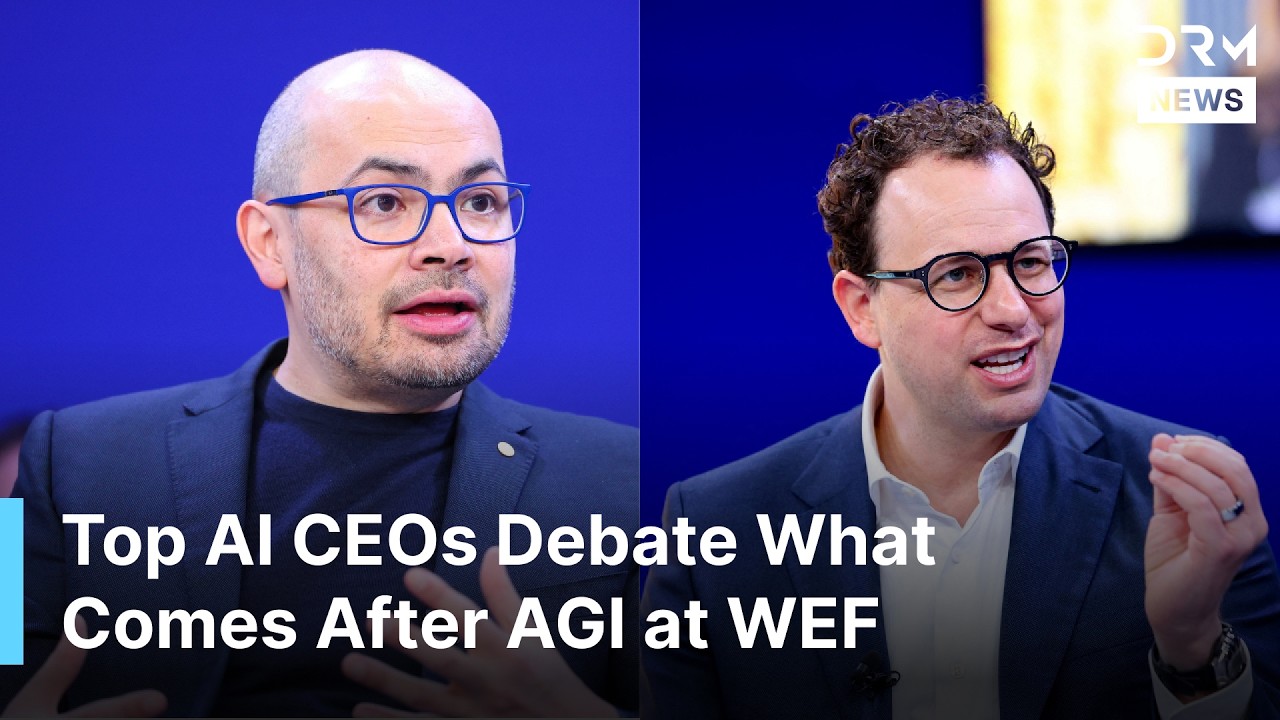
This discussion between Dario Amodei (Anthropic) and Demis Hassabis (Google DeepMind), moderated by a journalist, explores the timeline for achieving Artificial General Intelligence (AGI), the potential risks and benefits, and the geopolitical implications of AI development. They discuss the progress in AI coding capabilities, the potential for AI to accelerate its own development, and the societal challenges posed by rapid AI advancement, including job displacement and the need for international cooperation.
- AGI Timelines: Both experts maintain their previous timelines for achieving AGI, with potential for acceleration through AI-driven coding and research.
- Societal Impact: Concerns about job displacement, economic inequality, and the need for new societal structures to address these challenges are raised.
- Geopolitical Risks: The competitive landscape between the US and China, and the potential for misuse of AI by authoritarian governments, are highlighted as significant risks.
Introduction
The conversation begins with an introduction to the speakers, Dario Amodei and Demis Hassabis, and the topic of discussion: the day after AGI. The moderator notes the anticipation for this discussion, framing it as a significant event in the AI field. The initial focus is on updating previous predictions about the timeline for achieving AGI and exploring the potential consequences of its arrival.
AGI Timelines and Progress
Dario Amodei reaffirms his previous timeline, suggesting that a model capable of performing at the level of a Nobel laureate across many fields could be achieved by 2026-2027. He highlights the progress in AI coding capabilities, where AI models are increasingly able to write code with minimal human intervention. Demis Hassabis remains on a similar timeline, noting the remarkable progress but also pointing out the challenges in automating areas like natural science, where verification is more complex.
Competition and Independent Model Makers
The discussion shifts to the competitive landscape in AI development, with Google DeepMind regaining its position at the top of the leaderboards. Dario Amodei addresses the challenges faced by independent model makers, emphasising the exponential relationship between model capability and revenue generation. He expresses confidence in Anthropic's ability to succeed by focusing on building the best models and solving important problems.
Closing the Loop and Self-Improvement
The conversation explores the possibility of AI models closing the loop and powering their own development. Demis Hassabis believes that full closure of the loop is an unknown, potentially requiring AGI itself in domains with more complexity. Dario Amodei discusses his upcoming essay, which addresses both the immense potential and the grave risks associated with AI, framing the challenge as navigating the technological adolescence of AI without self-destruction.
Impact on Jobs and the Labor Market
The discussion turns to the potential impact of AI on jobs and the labor market. Dario Amodei reiterates his prediction that half of entry-level white-collar jobs could be gone within one to five years. Demis Hassabis suggests that while some jobs will be disrupted, new and more valuable jobs will be created. Both acknowledge the potential for AI to overwhelm the ability to adapt, leading to significant economic and societal challenges.
Government Response and Societal Impact
The speakers express concern about the lack of adequate government response to the potential societal impacts of AI. Demis Hassabis highlights the need for institutions to distribute the new productivity and wealth generated by AI more fairly. He also raises questions about the human condition and the need to find new sources of meaning and purpose in a post-scarcity world. The risk of a popular backlash against AI is also discussed, with Demis Hassabis emphasising the importance of demonstrating the unequivocal good that AI can bring to the world.
Geopolitical Risks and International Cooperation
The conversation addresses the geopolitical risks associated with AI development, particularly the competition between the US and China. Dario Amodei advocates for not selling chips to China as a key measure to ensure sufficient time to handle the risks. He criticises the administration's logic of binding China into US supply chains, comparing it to selling nuclear weapons to North Korea. The need for international cooperation and minimum safety standards for AI deployment is emphasised.
Malign AI and Potential Risks
The discussion explores the potential risks of a malign AI, with both speakers acknowledging the importance of addressing these risks through scientific research and collaboration. Dario Amodei emphasises the need for guardrails and caution against racing ahead without proper safety measures. Demis Hassabis expresses confidence in human ingenuity to solve the technical risk problem, provided there is sufficient time and focus.
Fermi Paradox and Future Predictions
A question from the audience raises the Fermi paradox, prompting a discussion about the potential reasons for the absence of observable alien civilisations. Dario Amodei dismisses the idea that AI-related self-destruction is the explanation, suggesting that humanity is past the great filter. The speakers conclude by sharing their predictions for what will have changed by the time they meet again next year, focusing on the development of AI systems building AI systems and the need for continued research into areas like world models and continual learning.

