
Brief Summary
This video discusses how the Philippines is standing up to China in the South China Sea using Japanese-built Parola-class patrol vessels. It highlights several incidents where these vessels have successfully defended Philippine waters against larger Chinese ships, including a notable collision caused by a failed Chinese manoeuvre. The video also examines the strategic and legal context of the conflict, the Philippines' approach to countering Chinese aggression, and the factors contributing to the success of the Parola-class vessels.
- The Philippines Coast Guard has successfully pushed back Chinese vessels from its exclusive economic zone using Parola-class patrol vessels.
- A failed Chinese "Pinsir" manoeuvre resulted in a collision between two Chinese ships due to the superior speed and agility of a Philippine vessel.
- The Philippines employs a comprehensive strategy involving legal challenges, transparency, and strengthening alliances to counter China's grayzone tactics.
Philippine Coast Guard vs. Chinese Vessels
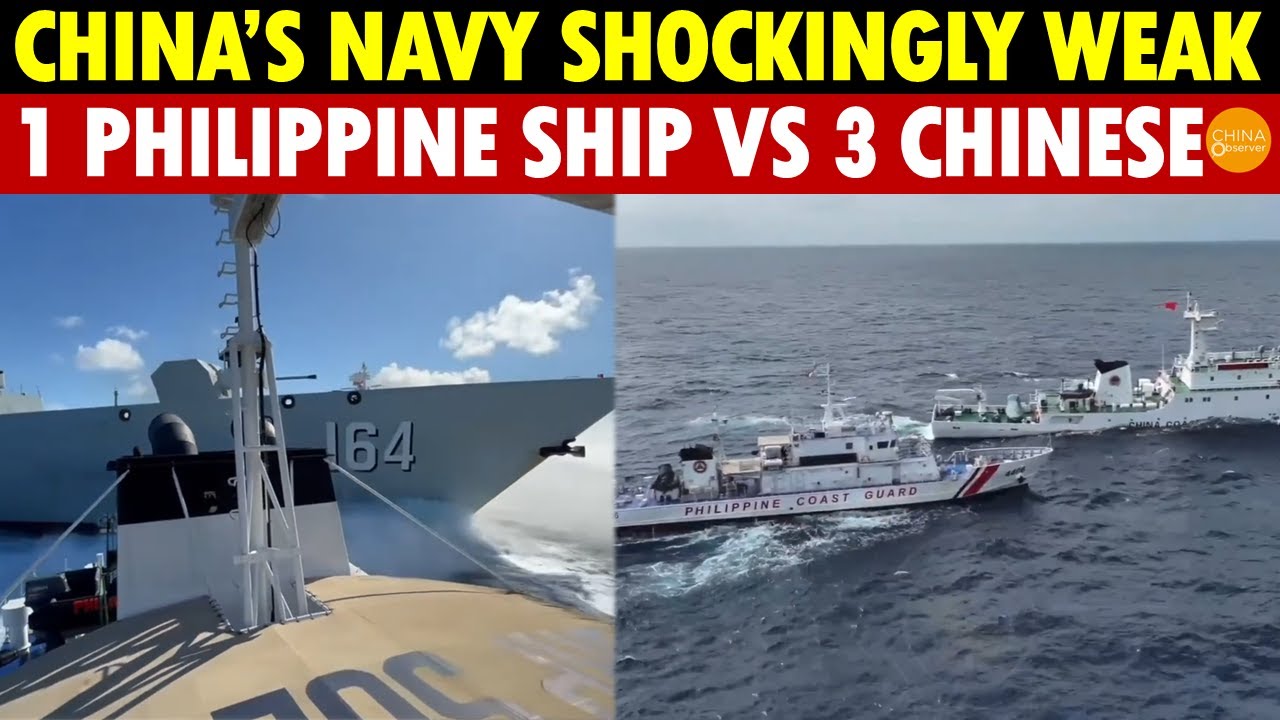
On November 30th, the Philippine Coast Guard's BRP Cabra successfully pushed a Chinese Coast Guard ship out of contested waters in the South China Sea. Philippine forces also tracked two larger Chinese Coast Guard vessels, maintaining a distance of nearly 100 nautical miles beyond the Philippines' exclusive economic zone. The BRP Cabra blocked Chinese vessels attempting to enter the Maritime Zone of Sambalis Province, actions that the Philippines asserts violate international law, including the Philippine Maritime Zones Act, the United Nations Convention on the Law of the Sea, and the 2016 arbitral ruling. The Philippines has repeatedly prevailed against larger Chinese opponents, with the Japanese-built Parola-class patrol vessels playing a key role.
The Parola Class Patrol Vessels
The Parola class gained attention after an incident on August 11th, when the BRP Suluan was harassed by a Chinese Coast Guard ship and missile destroyer while delivering supplies near Scarboro Shaw. The Chinese ships attempted to box in the patrol vessel but collided with each other due to misjudgement. The destroyer sustained serious damage, and the Coast Guard ship was heavily damaged, with reports suggesting possible fatalities. The BRP Suluan is one of ten Parola-class patrol vessels built by Japan for the Philippine Coast Guard. The BRP Cabra, a sister ship, also achieved success against three Chinese vessels. These vessels measure 44.5 meters in length, have a displacement of 321 tons, and a top speed of 25 knots, constructed by Japan Maritime United Corporation.
China's Strategy and the "Pinsir" Manoeuvre
China avoids direct military confrontation with the Philippines, instead employing tactics like water cannons, militia fishing vessels, and ramming. The Philippines has shown restraint to prevent escalation while standing firm on its sovereign rights. China has attempted coordinated "Pinsir" manoeuvres to force collisions, but these have failed due to the Parola class vessels' speed and agility. In the August 11th incident, the Chinese ships involved were the militia vessel Nangu (an upgraded 056 class corvette) and the 052D class destroyer Guin. The BRP Suluan abruptly accelerated, slipping through the trap and causing the Nangu to ram the Guin. Analysts estimate the Suluan reached at least 35 knots during its breakout, exceeding its published maximum speed.
Japanese Origins and Capabilities
The Parola-class patrol vessels were delivered under a 2013 agreement between Japan and the Philippines, facilitated by Japan's "three principles on transfer of defence equipment." Japan provided a loan of approximately $190 million for the program, structured as official development assistance. Japan Marine United built the vessels at its Yokohama yard, describing them as comparable to Japan's own 180-ton Coast Guard patrol ships. Each vessel carries a crew of 25 and is powered by two MTU diesel engines, providing a range of 1,500 nautical miles. Construction of the first ship began in 2016, and the entire fleet was completed by 2018.
Features and Armament
The Parola-class vessels are equipped with Furuno navigation radars, advanced radio communication systems, and bulletproof bridge panelling, a standard feature on Japanese patrol craft since a 2001 incident involving a North Korean spy ship. They also have night vision cameras, electronic warning banners, searchlights, and a fast rigid-hulled inflatable boat. While initially delivered unarmed, the Philippines fitted six of the boats with Israeli remote weapon stations armed with 12.7 mm heavy machine guns and infrared targeting systems in 2021.
Speed and Design Origins
Official specifications list the Parola class's maximum speed at 25 knots. However, the BRP Suluon's performance has led experts to believe that the ships may be concealing their full capabilities. Analyst Zen Yu observed that the Philippine Parola-class vessels are derived from Japan's Bison-class design. This secrecy contrasts with China's tendency to inflate its own specifications.
The Philippines' Legal and Strategic Position
In the South China Sea, seven parties hold sovereign claims, but China directs its harshest treatment towards the Philippines. This is largely due to Manila's 2013 challenge against China at the Permanent Court of Arbitration, which it won decisively. The tribunal ruled that China's 9-dash line has no basis in international law. Despite its modest military strength, the Philippines holds a strong legal, moral, and diplomatic position. The Philippines documents every incident to demonstrate China's interference with lawful activities, reinforcing global awareness of the 2016 arbitration ruling.
Countering Chinese Aggression
Philippine Armed Forces Major General Elmer Sudio outlined four national initiatives to counter Chinese aggression: upholding sovereignty, safeguarding freedom of navigation, reinforcing a rules-based international order, and strengthening security in the cognitive and cyber domains. The Philippines maintains an active presence in the West Philippine Sea while exercising restraint, strengthens ties with allies, pursues a transparency campaign to counter China's narratives, and implements a whole-of-nation strategy against China's grayzone tactics.
Political Warfare and Future Acquisitions
Beijing persists with political warfare, using the United Front Work Department to acquire Philippine documents, exploit visas, influence infrastructure, spread disinformation, and sway the Filipino-Chinese community. The United Front Work Department also conducts espionage, corrupts officials, weakens social unity, carries out economic sabotage, finances political candidates, and suppresses discussion of West Philippine Sea issues. The Philippine Navy's core surface fleet centres on Joseé Risal-class frigates and HDC 3100-class frigates. Manila has also acquired Brahmos anti-ship missile batteries from India. Future acquisitions are expected to include Kilo-class submarines and Phungass corvettes.
Current Dynamics and Factors Influencing Caution
Recent years have seen mostly grayzone confrontations, with Chinese interference in Philippine supply lines countered by the Coast Guard. Three Chinese vessels recently kept their distance from a lone Parola-class patrol boat due to Philippine crews' high morale and ship handling skills, local navigators' knowledge of the waters, and memories of China's self-collision. Declining quality and motivation within China's forces, amid economic troubles and social unrest, also contribute to their caution. The Parola-class patrol vessel has challenged the perception of Chinese naval invincibility, providing an example for other South China Sea nations.

